
The one-minute balance check.
The opener doesn't lift your door; the spring does. Which means the single most useful thing an owner can do between services is find out how well the spring is carrying the weight, and there's a safe, standard way to do exactly that with your own hands. Here it is, including the part most guides skip: when not to try it.
Stop: do not run this check if any of these are true
- You heard a loud bang from the garage recently, or there's a visible gap in the spring coil above the door
- A lift cable is hanging slack, frayed, or off its drum
- The door is crooked in its opening or has come off a track
- The door already feels like dead weight from the opener's behaviour
Any of those means the counterbalance may already be gone, and a door without its counterbalance is a very heavy object waiting for a reason to move. Leave it, keep people and cars clear, and book the repair instead.
The check, in five steps
- 01Close the door fully
The whole check happens from closed. Clear kids, pets and bonnets out of the opening first. If your remote lives in the car, bring it inside with you so you're not tempted to test anything under power.
- 02Pull the red release cord
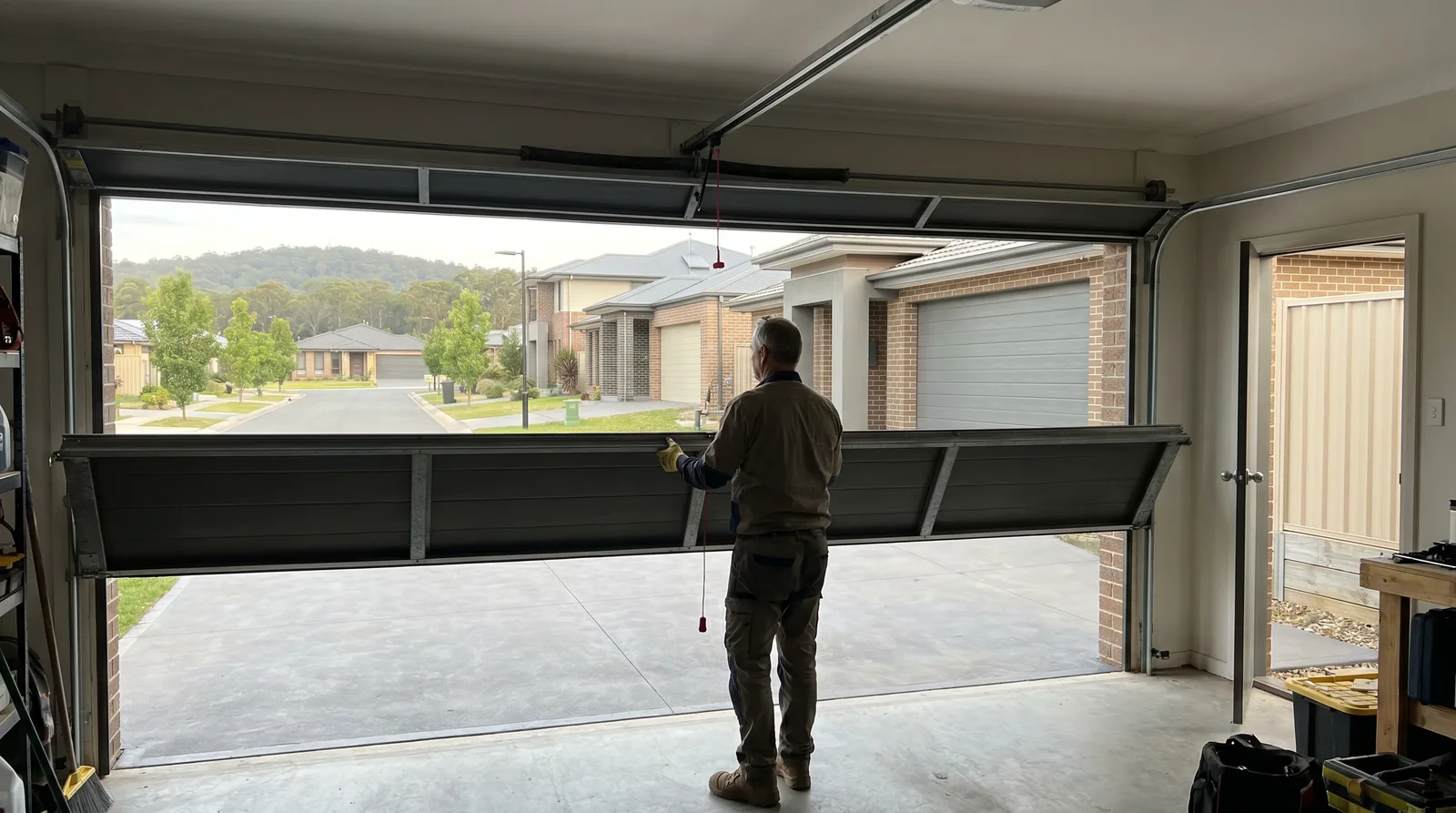
The red handle hanging from the opener rail disconnects the door from the drive so you can move it by hand. Pull it once, firmly, with the door closed. This is exactly what the cord is for; you're not breaking anything.
- 03Lift by hand to about waist height
A healthy door should feel surprisingly light, a few kilos of effort, not a deadlift, because the spring is doing the real work. Lift smoothly, keep your fingers on the handle or the bottom panel's face, never in the panel joins.
- 04Let go, gently, and watch
Ease your hands off at around waist height. A balanced door holds roughly where you left it, maybe creeping a few centimetres. That's the whole test: the door, holding its own weight in mid-air, is the spring passing its exam.
- 05Reconnect
Close the door by hand, then run the opener once; the trolley picks the door back up automatically on most units. Done. Diarise the next check for the change of season.
Reading the result
| What the door did | What it means | What to do |
|---|---|---|
| Held its position, felt light | Spring tension is carrying the door correctly. The machine is healthy. | Nothing. Re-run the check each season and enjoy being the street's most organised garage. |
| Drifted steadily down | Tension is below where it should be: the spring is tired or the door has picked up weight (moisture in older panels does this). | Book a service and tune. Unhurried, but on the list: a drifting door is loading the opener every cycle. |
| Dropped hard or felt very heavy to lift | The counterbalance is substantially gone: a spring at or past failure. | Don't cycle it again, by hand or by opener. Book a repair and mention the result. |
| Flew upward when released | Over-tension: less common, but a real fault with its own risks to hardware and hands. | Same call: book it in, and leave the door closed meanwhile. |
One boundary worth stating plainly: this check reads the spring, it never adjusts it. Winding or unwinding a torsion spring takes purpose-made bars and training, because the stored tension that lifts a hundred-plus kilos of door is exactly the tension that injures people who improvise. Reading is yours; winding is ours. That's the honest division of labour.
Sources and notes
- ACCC Product Safety publishes recall and safety information for garage door openers in Australia; if your opener is old enough that you're unsure of it, their recall search is worth a minute.
- Automatic openers sold here are built to the Australian and New Zealand safety standard for powered doors (AS/NZS 60335.2.95), which is where behaviours like auto-reverse come from. We describe the standard's role rather than certifying any particular unit: what your opener complies with is a matter for its maker's documentation.
- The release-cord-then-hand-lift balance test described above is the standard owner's check recommended across major door and opener manufacturers' care guides.
Tell us what the door is doing.
Open a job card with a few details and the crew comes back to you ready: right parts on the van, right questions already asked. No call centre, no hold music, no hard sell.